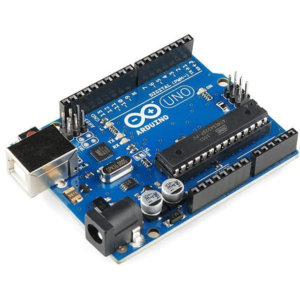
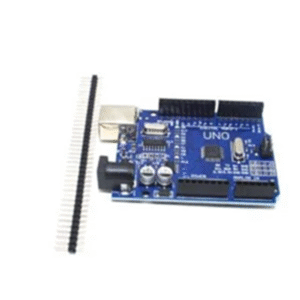
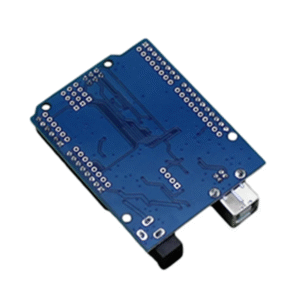
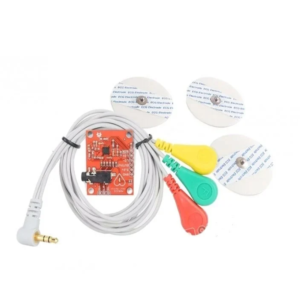
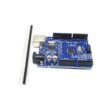
The Arduino Uno R3 is an open-source microcontroller board based on the ATmega328 chip, designed to simplify electronics projects for beginners and professionals alike. It features 14 digital input/output pins (6 of which support PWM), 6 analog input pins, a 16 MHz ceramic resonator, a USB connection port, a DC power jack, an ICSP header, and a reset button. This comprehensive setup ensures users can start working on their projects immediately by connecting the board to a computer via USB or powering it with a DC adapter or battery.
The Uno R3 replaces the FTDI USB-to-serial driver chip used in earlier models with an Atmega16U2 (or Atmega8U2 in versions up to R2) for USB-to-serial conversion. It supports dual power sources, automatically selecting between USB or an external power supply.
External power can be supplied using an AC-to-DC adapter or a battery. The adapter connects through a 2.1mm center-positive plug to the power jack, while battery leads attach to the GND and VIN pins. The board operates on an external supply voltage of 6 to 20 volts, though stability and safety considerations dictate a recommended range of 7 to 12 volts. If supplied with less than 7V, the 5V output may become unstable, and voltages exceeding 12V risk overheating the voltage regulator, potentially damaging the board.
We care about your privacy
In order to provide you a personalized shopping experience, our site uses cookies. By continuing to use this site, you are agreeing to our cookie policy.